Partners

“I’ve Got Time”: Why Avoiding the Estate Planning Conversation Isn’t a Character Flaw


By Dr. Shatiea Blount, LCSW-C
We don’t wait for a birth to prepare for a new life. Why, then, do we wait for a crisis to prepare for the end of one?
It’s a question worth sitting with, especially for the accomplished, capable people who otherwise have their lives remarkably in order. The career is on track. The savings account has a plan behind it. The calendar is color-coded. And somewhere on the list, quietly pushed to next quarter for the third year running, sits a will, a healthcare directive, or a conversation with an aging parent that keeps getting postponed.
This isn’t laziness, and it isn’t denial in the way we usually mean the word. It’s something closer to a grief response than a character flaw.
The Three Things Standing in the Room
In clinical conversations about end-of-life planning, three barriers show up again and again, and they rarely travel alone.
Shame. Many people quietly assume their finances or paperwork aren’t tidy enough to bring to a professional, so they say nothing rather than risk that exposure. The irony is that even people who are financially prepared often stay silent, worried that naming a plan out loud will spark conflict with family members who see things differently.
Distrust. For some, the hesitation isn’t about the paperwork at all. It’s about who gets to carry out their wishes once they can’t advocate for themselves. When someone doesn’t fully trust a family member to honor their intentions, avoiding the conversation can feel safer than having it and being ignored anyway.
A false sense of time. This is the quietest barrier and the one most disguised as confidence. Many people reason their way out of urgency: no dependents, a manageable debt load, a life insurance policy already in place. The math checks out on paper. But that math is often a stand-in for something less measurable, a felt sense that catastrophe is a someday problem rather than a today one.
Why the Brain Does This
There’s a body of psychological research that explains why even thoughtful and self-aware people organize their lives around avoiding thoughts of death. Terror management theory holds that human beings manage the anxiety of their own mortality by building meaning, routine, and self-worth around things that will outlast them, careers, causes, legacies (Greenberg et al., 1986). Death awareness doesn’t sit quietly in the background. It actively shapes behavior, often by redirecting attention away from the very planning that would reduce risk for the people left behind.
Put simply: avoidance isn’t a flaw in your reasoning. It’s a very old survival strategy doing exactly what it evolved to do.
The Worst Week
Here’s the part that tends to reframe the conversation for people who consider themselves put-together. When there is no plan in place, the family doesn’t get spared the hard conversation. They inherit it, at the worst possible moment, with no roadmap and no time to think clearly. Decisions that could have been made calmly over coffee get made in a hospital hallway or a funeral home lobby instead.
It’s also worth naming that this isn’t a risk distributed equally. Research shows that racial disparities in life expectancy persist across every level of income and education (Tulane University School of Public Health and Tropical Medicine, 2023). For some people, “I’ve got time” is a riskier bet than it looks on paper, which makes the planning conversation not just a personal choice but, for some, a health equity issue.
Reframing the Delay
None of this is about guilt. We are naming avoidance for what it actually is: a grief response, not a character flaw. The goal isn’t to shame anyone into an attorney’s office by next Tuesday. It’s to normalize that the emotional work, the shame, the distrust, the discomfort of imagining your own absence, has to happen before the legal work is even possible.
That emotional groundwork is where therapy earns its place at this table. An attorney can draft a will. A financial planner can help you organize your wealth. Neither is trained to sit with the anxiety that makes people avoid the meeting in the first place.
An Invitation, Not a Deadline
If any of this sounds familiar, you’re not behind. You’re human. But if you’ve been carrying “I’ll get to it” for a while now, consider this your gentle nudge that seeking support here isn’t weakness, it’s strength. That’s the whole idea behind therapy for the strong friend: the ones who hold everything together deserve a space to put something down.
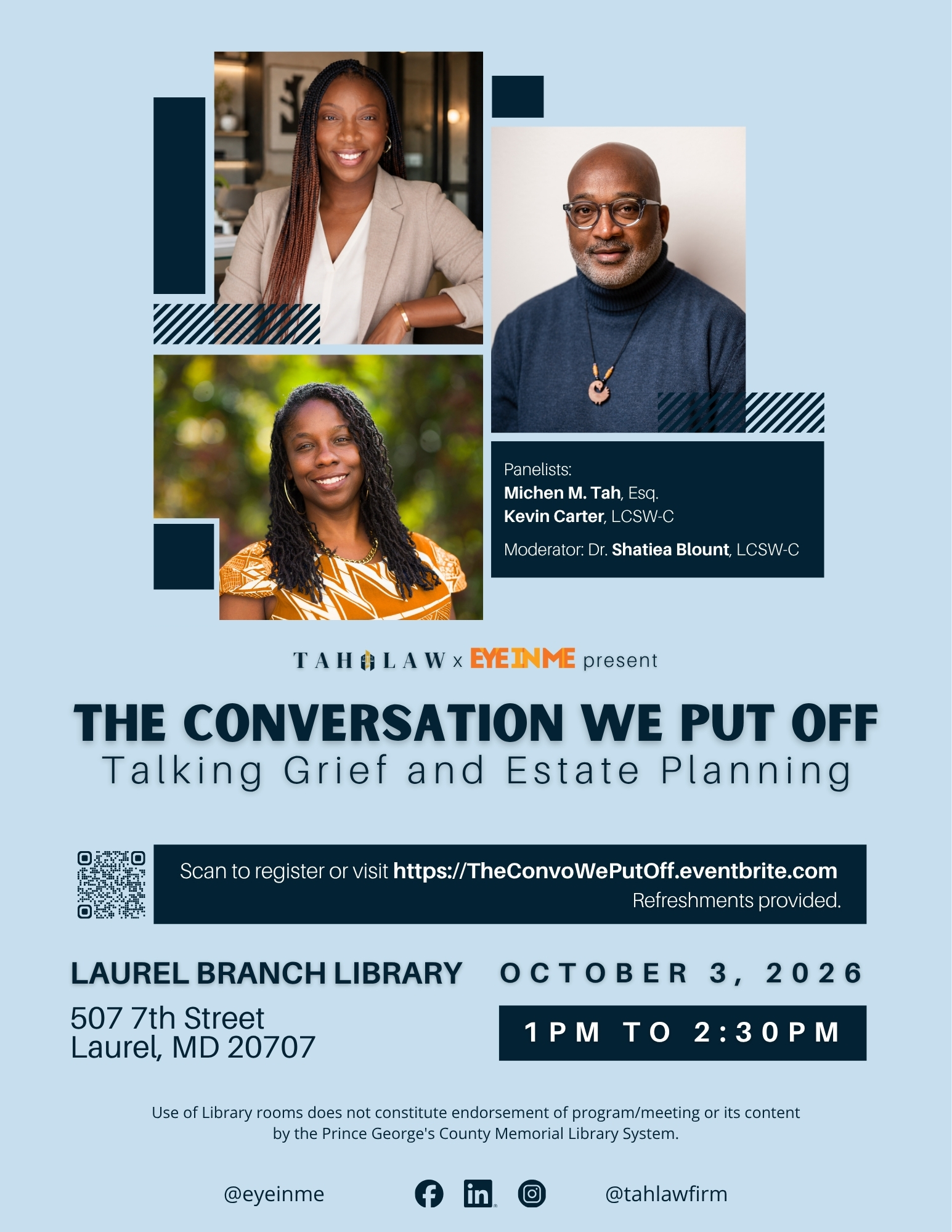
On Saturday, October 3rd, join Eye In Me and Michen Tah of Tah Law for a candid conversation about the part of end-of-life planning nobody covers, the emotional work that has to happen before the legal work is possible. Register Here. You’ll leave with language for starting this conversation with a parent, spouse, or adult child, a clearer picture of what happens in Maryland when there’s no plan in place, and a better understanding of why this kind of avoidance is a grief response, not a flaw.
References
Greenberg, J., Pyszczynski, T., & Solomon, S. (1986). The causes and consequences of a need for self-esteem: A terror management theory. In R. F. Baumeister (Ed.), Public self and private self (pp. 189–212). Springer-Verlag.
Tulane University School of Public Health and Tropical Medicine. (2023, June 23). Black maternal health in the U.S.https://publichealth.tulane.edu/blog/black-maternal-health-racial-disparities/

[social_warfare]